

Reframe Fundraising: Responsibility, Privilege and Opportunity
 I’m a huge fan of the Greater Good Science Center at UC Berkeley, and I often apply their research to nonprofit fundraising and marketing. This article there, How to Find Your Purpose in Life, really struck me.
It affirmed something I’ve learned over more than 30 years as an in-house development professional:
You serve your donors every bit as much as they serve your mission.
Pause and let that sink in.
You have a mission. A purpose. Donors can help you achieve it.
Your donors are searching for purpose. You can help them find it.
That’s the essence of philanthropy: a symbiotic relationship. And you have a critical role to play in fostering it.
Your Real Job: Facilitating a Philanthropic Journey
Your job isn’t just to raise money.
Your job is to facilitate your donor’s philanthropic journey — their journey toward meaning and purpose.
So, what is fundraising really all about?
It’s about the donors, stupid.
I hope that doesn’t offend. I’m borrowing from James Carville’s famous 1992 reminder — “It’s the economy, stupid” — used to keep Bill Clinton’s campaign focused. Consider this your own sign to hang in fundraising headquarters:
It’s about the donors.
Fundraising is mostly about donors (aka people) first; money second. When you get the first part right, the second follows naturally.
Here’s a question that may sound odd:
Does your mission statement implicitly say:
- “We exist because people need to give,”
or - “We exist to help people find meaning through giving”?
A few organizations get close to the latter. Not nearly enough.
Why This Matters
If your organization is largely supported by philanthropy, this should be obvious:
- Without donors, your organization ceases to exist.
- Without your organization, donors can’t become the change they want to see.
Philanthropy comes from the Greek philos (love) and anthropos (humankind). One person offers love; another receives it. Often, the roles shift back and forth.
When your focus moves from getting money to helping donors make a difference, everything becomes easier. The money doesn’t disappear; it simply becomes the byproduct of meaning.
Maslow Was Right—and You’re Part of the Equation
This work is ultimately about self-actualization, the highest level of Maslow’s hierarchy of needs.
Once people have food, shelter, and safety, they seek belonging, purpose, and a reason to exist beyond survival. They want to recognize the best version of themselves in the mirror.
You have the power to help donors find that version.
That’s why I often describe development professionals as donor sherpas, tour guides, or directors of donor experience.
At its core, your role is simple:
You are a philanthropy facilitator.
You help people who care channel their love in meaningful directions.
A Lesson from Volunteers (That Applies to Donors)
Years ago, I worked at a social service agency with many volunteer programs. The irony? The volunteer coordinators were not volunteer-centered.
They saw volunteers as a means to an end — helping clients. Important, yes. But that’s not why people volunteer.
People volunteer to:
- Feel useful
- Belong to something
- Be of service
- Find meaning
By treating volunteers like tools instead of humans, the organization shortchanged them. We never had enough volunteers, and the experience wasn’t joyful.
So, I facilitated a series of retreats focused not on client needs — but volunteer needs. Slowly, coordinators realized volunteer needs weren’t so different from client needs. Empathy followed. Engagement improved.
Donors are no different.
You’re in the Happiness Delivery Business
You are not just in fundraising.
You are in the happiness and meaning delivery business.
And when individuals are happier and more connected, communities are healthier and stronger.
In the Greater Good article, author Jeremy Adam Smith suggests people often seek purpose because they feel isolated. Many of his recommendations align beautifully with what mission-driven organizations already do best:
- Reading and learning, which build empathy and connection
- Turning pain into service, a powerful philanthropic motivator
- Cultivating awe, which connects us to something larger than ourselves
- Practicing gratitude, which increases generosity and contribution
- Encouraging altruism, through giving and volunteering
- Building community, where people feel seen and valued
- Telling meaningful stories, especially where personal and organizational purpose intersect
Sound familiar? It should.
Begin with the Greater Good in Mind
If facilitating philanthropy makes people happier and healthier while advancing your mission, that’s a win-win-win — for donors, your organization, and society.
So why do so few nonprofits explicitly place donors at the heart of their mission?
Donor-centered fundraising asks you to visualize what you and your donors accomplish together. How does it feel? Pride? Gratitude? Awe?
That emotional response is the point.
Match the Greater Good to the Individual Good
Existentialists say “existence precedes essence.” I find this incredibly useful in donor engagement.
Your donors are more than job titles or demographics. They’re becoming something.
Ask yourself:
- Who are they trying to be?
- What essence are they seeking?
- How can I help them get there?
Too often, we assume giving must be selfless. Why? There’s nothing wrong with receiving meaning, joy, or identity in return.
In fact, nearly every philanthropist I’ve honored has told me some version of:
“I get more out of this than I give.”
Psychologists aren’t surprised. A sense of purpose improves physical health, mental health, and resilience. Purpose evolved to help humans accomplish big things together.
Survival of the Kindest
Darwin didn’t just write about survival of the fittest. He also wrote about survival of the kindest.
Communities where people cared for one another endured. Empathy, not strength alone, made humans resilient.
When people lack purpose, they feel isolated. That’s why they volunteer. That’s why they give. They’re looking for connection and a path forward.
Reconnect with Your Own Purpose
If you’re struggling to remember why you do this work, look around.
Look at your colleagues.
Look at the people you serve.
Look at your donors.
What unites you? What impact are you making together?
If you’re no longer inspired by that story, it may be time to find a new community — or rediscover the one you already have.
One rooted in awe, gratitude, altruism, and purpose.
Want Some Help Reconnecting?
 How much time do you spend being genuinely thoughtful about your goals and objectives? And do you take as much time as you would like to think strategically about your plan to achieve these ends? Not just mindlessly editing or tweaking last year’s plan, but really digging deep into why you’re doing these things? And whether there might be other more effective ways to get to where you want to go?
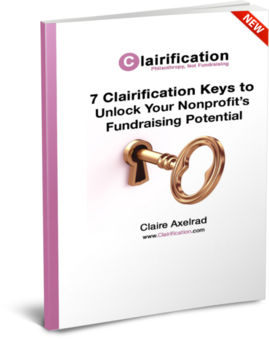
My 7 Clairification Keys to Unlock Your Nonprofit’s Fundraising Potential may be just the resource you need. Spend a little time — for yourself and for your organization — to dig into the worksheets and exercises in this Guidebook. Refresh your thinking, and refresh your plans.
All Clairification resources come with a no-questions-asked, 30-day refund policy. If you’re not happy, I’m not happy.
Photo by Tim Mossholder on Unsplash


