

4 Step Guide to Successful Online Nonprofit Fundraising Today, Not Yesterday
 This is a smart way to organically build a monthly donor program.
1. Make monthly giving the default on your donation landing page.
2. Create an ask string with smaller amounts — numbers that make sense, especially for non-major donors, when multiplied by 12 months.
3. Highlight an amount close to your median monthly gift. This creates an anchor that short-circuits the decision-making process, making it easier for the donor to act.
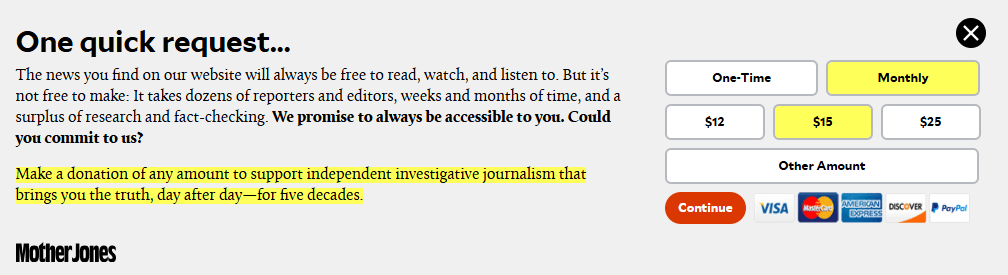
4. Include the option to make a one-time gift.
5. When the potential donor clicks on this option, make sure the ask string switches to larger numbers that make sense for a non-recurring gift.
6. Always include an “other” option so donors can give less, or more, as the spirit moves them.

How did I find this?
I happened to be reading an online article from Mother Jones magazine.
As I was midway through the article, this ask popped up at the bottom of the article.
It didn’t come too soon. It didn’t come too late. The timing was just right.
I could have easily clicked the upper-right-hand corner X to disappear it if I’d wanted to. I still had control, and didn’t feel pressured to donate in order to keep reading.
But, heck, I’m a fundraiser so I had to look behind the curtain.
I liked what I saw.
So, I’m sharing it with you.
They did everything right.
So should you.


hi Claire, this is great but I do caution on the defaulting to monthly. UNLESS it is really clear on the button that says monthly, the gifts say monthly, so many donors do not read or don’t know what the color differences mean when the frequency is indicated. Especially during busy fundraising season, donors want to make a gift and if they accidentally make a monthly gift, it becomes a bad donor experience. so take a look at your donation form and have some folks test it first. When it comes to monthly giving you really want the donor to commit and know what they’re commiting to.
Absolutely correct Erica. Another reader expressed a similar concern, to which I’ve replied in the comments under the post. You do need to be clear as a bell! And I like the idea of testing. I’d just err on the side of the default — done carefully — because the lifetime value of recurring donors is worth the little bit of risk.
One reader worried about making monthly giving the default, as it can create problems with donors who intended to make a one-time gift. True. But, you can take proactive steps to prevent that from happening.
It generally occurs when:
The default is checked “quietly,” so it’s easy for it to go unnoticed by a donor.
The ask string amounts for monthly and annual remain the same (so someone ends up checking $50 or $100 and finding out they’ve inadvertently made a $600 or $1,200 gift).
In this example, the monthly option and amount are both loudly highlighted in yellow. It’s pretty difficult to NOT see this.
It’s also possible with many of today’s CRMs to make the monthly ask string responsive to a donor’s past giving history. Again, this mitigates against the donor winding up giving significantly more than intended.
One additional step they might have taken here (which I should have mentioned) was to change the highlighted sentence at the bottom [ “Make a donation of any amount to support independent investigative journalism that brings you the truth, day after day—for five decades”] on the monthly default screen to something sharing why monthly gifts matter. It would be one more way to assure the donor understood they were agreeing to a recurring gift. In fact, this organization does have such a sentence on their regular donation landing page: “Monthly gifts sustain our unflinching reporting—keeping us ready for whatever comes next. And as thanks, you’ll receive a free subscription to award-winning Mother Jones magazine.”
I recommend making monthly the default because it gently nudges donors towards the higher-value option. You’ll raise more money and keep MANY more donors overall (average ongoing donor retention today is roughly 45% vs. 80 – 90% for monthly supporters).