
Time to Reframe How You Do Nonprofit Fundraising
 Nonprofits put enormous time and care into donor communications. Yet too often, appeals, emails, newsletters, websites, and event promotions fail to generate the response organizations hope for.
Why?
Usually. it’s not because the mission isn’t compelling.
It’s because the communication isn’t connecting quickly or emotionally enough.
Today’s donors are overloaded with information and constantly distracted. They scan before they read. They decide in seconds whether something feels relevant, engaging, and worth their attention.
The good news?
Small shifts in how you write and structure communications can dramatically improve donor engagement.
Here are seven – count them! — practical ways to strengthen your fundraising and marketing communications before peak giving season arrives.
1. Pull Readers Into the Story Immediately
Many nonprofit communications begin too formally or too broadly:
“Since 1987, our organization has provided comprehensive services to underserved populations…”
That may be factually correct, but it doesn’t create emotional momentum.
Instead, open with a moment, image, or emotion that pulls readers into the story.
For example:
“Maria stood in the grocery aisle quietly putting food back on the shelf because she realized she didn’t have enough money to pay for everything in her cart.”
Or:
“When James arrived at the shelter that night, he carried everything he owned in a torn backpack.”
Specificity creates connection.
One especially effective technique used by skilled fundraising copywriters is occasionally stepping out of the story to speak directly to the reader.
For example:
- “What happened next surprised everyone.”
- “Let me repeat that, because it’s important.”
- “It broke my heart to hear her say that.”
These small moments of direct guidance help readers stay emotionally engaged and invested in the story.
2. Stop Writing About Your Organization So Much
One of the most common communication mistakes nonprofits make is focusing too heavily on themselves.
Donors are less interested in your internal processes than in the difference their support makes.
People aren’t interested in reading a term paper that’s all about you. They care about what changes because your organization exists.
Compare these examples:
Organization-centered:
“Our organization expanded its food pantry distribution model into three additional neighborhood sites.”
Donor-centered:
“More parents can now bring home groceries for their children without traveling across town for help.”
Same accomplishment. Very different emotional impact.
As you review your communications, pay attention to how often you use words like:
- we
- our
- organization
- program
Then compare that to how often you write about:
- donors – like you
- community members – like you
- beneficiaries – people helped
- transformation – positive, meaningful change
- outcomes – based on constituent values
The goal isn’t to erase your organization from the story. It’s to reposition your organization as the connector between donor generosity and meaningful impact.
3. Focus on Benefits — Not Features
Nonprofits often describe what they do without fully explaining why it matters — in human terms.
That’s the difference between features and benefits.
Feature:
“We planted 5,000 trees this year.”
Benefit:
“Those trees will help reduce flooding, cool neighborhoods during heat waves, and improve air quality for thousands of local residents.”
Feature:
“We opened two additional school-based food pantries.”
Benefit:
“More children will go to sleep with full stomachs, ready to learn the next morning.”
Benefits help donors visualize positive impact.
Whenever possible, translate organizational accomplishments into real-life outcomes people can picture and feel. The fact you “planted trees” can land like a big “So, what?!”
Helpful editing questions:
- Why does this matter to someone’s daily life?
- Why does this matter for the future?
- Why might this matter – on a feeling level — to the donor?
Keep asking yourself questions until the answers become tangible, emotionally heartfelt and humanly resonant.
4. Write About People, Not Programs
Programs don’t inspire giving nearly as much as people do.
This is especially important when writing:
- annual appeals
- gala promotions
- grant reports
- newsletters
- campaign emails
- website copy
For example:
Program-focused:
“Our workforce development initiative served 450 participants this year.”
People-focused:
“Because of donor support, 450 mothers and fathers trained for careers that now allow them to put food on the table, keep the lights on, and plan for a future with their kids that once felt out of reach.”
Or consider event promotion. Instead of focusing primarily on attendance numbers, decor, or entertainment, emphasize the human impact behind the event.
Typical gala copy:
“Join us for an elegant evening honoring community leadership.”
More compelling version:
“Join us to celebrate the people helping hungry families, isolated seniors, and vulnerable children find support and hope.”
People connect emotionally with people they feel emotionally compelled to help, not organizational infrastructure — no matter how proud you are of your network of 47 food pantries.
5. Design for Scanners First
Most people do not read content word for word. They scan.
And this is true for both hard copy and digital.
That means even strong writing can get ignored if it’s difficult to read or visually overwhelming.
A writer and designer’s job is to direct attention intentionally. Good formatting helps!
Make communications easier to scan by:
- using short, indented paragraphs
- adding clear headings and subheadings
- bolding key ideas sparingly
- grouping related information together
- breaking up dense text
- using bullet points where appropriate
Research consistently shows readers spend significant attention on the left side of a screen first. Important information should not be buried in long, unbroken blocks of text.
Think about your own behavior online.
When confronted with a wall of text, most people immediately look for:
- headlines – make yours compelling by using a headline analyzer [These are the two I use]
- white space – consider it oxygen; let your written piece breathe
- bolded phrases – not too many, but do draw readers to your most important points
- bullets – again, not too many
- visual cues – use photos that tell a story
Your donors do the same thing.
6. Make Your Calls to Action Clear, Specific and Distinct
Many nonprofit communications end with vague or passive language.
For example:
“To learn more about our programs, visit our website.”
Or:
“We hope you’ll support our work.”
Neither statement clearly communicates:
- what action the reader should take,
- why it matters,
- or why they should act now.
People are far more likely to respond when they understand exactly what their action will accomplish.
Compare these examples:
Vague:
“Please consider making a gift.”
Specific:
“A gift of $35 today will help provide a week of meals for a local senior.”
Or:
Passive:
“Learn more about our work.”
Active:
“See how your support helped 120 families stay housed this winter.”
You could even make it sharper by avoiding one especially common nonprofit phrase:
Weak:
“Your support makes a difference.”
Stronger:
“Your gift today can help a child start school this fall with food, supplies, and stable housing.”
That really demonstrates the difference between abstract appreciation and concrete impact.
It’s also important not to overwhelm readers with too many competing calls to action in a single communication.
For example, an email that simultaneously asks readers to do more than one of these things, may end up generating little response to any of them.:
- donate,
- register for an event,
- sign a petition,
- read a blog post,
- follow social media channels,
- and volunteer
When everything feels important, readers often choose nothing. It’s called analysis paralysis. Instead, decide on the primary purpose of each communication and make that action stand out clearly.
A focused message is almost always more effective than a crowded one.
7. Edit Ruthlessly Before You Hit Send
Strong nonprofit communication is rarely written perfectly in the first draft.
The real magic often happens during editing.
Before sending any donor communication, review it through the eyes of a busy reader seeing it for the first time.
Ask:
- Would this grab my attention quickly?
- Is the emotional takeaway clear?
- Have I made this about people and impact?
- Is there unnecessary jargon?
- Can anything be shortened?
- Is the call to action obvious?
- Would someone skimming this still understand the main message?
One useful exercise:
Read your message aloud.You’ll often hear places where the writing feels stiff, overly formal, repetitive, or unclear.
Another helpful trick:
Cut the first paragraph entirely.
Many openings simply “warm up” before the real message begins — lead with what’s important.
Small Changes Can Produce Big Results
You do not need to completely reinvent your organization’s communications strategy overnight.
Often, the most meaningful improvements come from small, consistent adjustments:
- stronger openings
- clearer impact language
- more donor-centered storytelling
- better formatting
- simpler calls to action
Before peak fundraising season begins, take time to review your appeals, emails, website pages, event promotions, and newsletters with fresh eyes.
The goal is not simply to communicate more.
It’s to communicate in ways that help donors feel connected, inspired, and confident their support truly matters.
Want More Help With Fundraising Appeal Tactics?
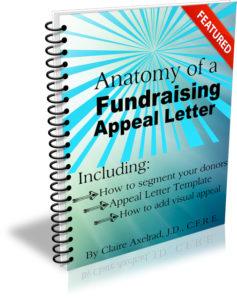 Get my Anatomy of a Fundraising Appeal + Sample Template — a thorough e-Guide with everything you need to put together an offer your prospect can’t possibly refuse!
This is super practical stuff I’ve learned over the past 35+ years. Plus, I’ll explain to you why I’m suggesting you take the recommended actions — so if anyone tries to dissuade you from doing what you know works, you’ll have the ammunition you need to stick to your guns. That’s how you’ll raise more money.
I guarantee you’ll raise way more than the modest cost of this Guide. If you’re not satisfied, you have my no-questions-asked, 30-day, 100% refund guarantee.
This 62-page e-Guide is a surprisingly quick read — and a true road map to creating a winning fundraising appeal.


