

Better Nonprofit Communications: 7 Simple Ways to Increase Donor Response

Reframing how you’ve done fundraising in the past is not optional.
It’s time for a change.
You must do it, because fundraising and nonprofit marketing have changed a LOT over the past ten years. Actually, over the past two years. There is absolutely no denying this at this point. You need to adapt. Or suffer the consequences.
If you’re still doing the same exact things you did ten, five, or even two years ago, it’s time to rethink. If you have leaders who doubt there’s a need for change, simply explain the reasons as I’ve outlined below:
1. Changes to do with technology.
The toolkit for fundraisers and marketers has become way more powerful.
Never before have there been so many tools to connect with so many customers with such scale and efficiency. And if fundraising staff don’t know about these tools, they can’t ask marketing staff to use them. Google ads. FB hangouts. Social media. AI, AI, AI. There are myriad ways to help your prospective donor through the research and decision-making process in ways not previously scalable.
More and more you need people on your staff who understand the digital world and digital tools. There are many technology solutions out there that didn’t exist even one year ago. If you haven’t upgraded your database, CRM, mail provider and apps recently, now is the time to give this some serious thought.
You need folks on your team to help you navigate the digital world strategically.
2. Changes to do with how people communicate.
You can no longer rely on a single communication channel.
Nor are you even in charge of your brand anymore. integrating these strategies across multiple channels to create a consistent brand. “Brand,” by the way, does not mean logo and design. It is who you are. Your identity. Your raison d’etre. The promises you make, and the promises on which you must consistently deliver. Which is why it’s important to establish a presence across multiple, integrated channels. People will find you, and form opinions about you, long before you’re even aware they exist. Even in for-profit commerce, today’s buyers are 60-70% through the decision-making process before engaging a salesperson.
What your constituents value begins with them; not with you.
The world has decidedly shifted from outbound to inbound marketing. If you want to find a need and fill it, then you must listen to and engage with your constituents to learn what they believe they need. People today are very informed. It’s not about you informing them anymore. They want to inform you. Tthey want to tell you when and where they want to hear from you. Folks have become adept at blocking out what they consider “noise.” The growth of permission based marketing is testimony to this trend.
3. Changes to do with branding.
Your brand is no longer a top-down exercise.
As alluded to above, people will learn and talk about you in ways that shape your brand – no matter what you yourself have to say on the matter. So your “about” page matters less than the “testimonials” you sprinkle throughout your website, blog, e-newsletter and social channels. And what people think, and say, about you will largely impact people’s willingness to support you philanthropically.
Which is a huge reason fundraising and marketing can no longer be separate silos.
Integrate your departments. Understand that from the outside looking in, you are ONE organization. No one cares which department crafted which message. What folks do care about is when they are bombarded by too many different messages — from different departments — with different calls to action. It’s confusing.
4. Changes to do with information overload.
A wealth of information creates a scarcity of attention and thus a need to efficiently allocate attention.
We live in the age of information overload. Human attention spans have decreased
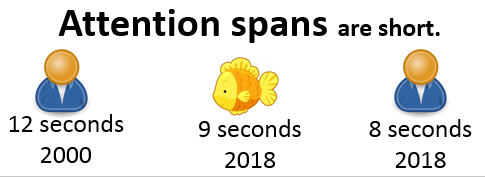 Today’s fundraisers and nonprofit marketers need to share responsibility for grabbing attention, creating awareness, building desire, stimulating engagement and inspiring investment. And they need to make a shift in how they communicate as well.
Visuals grab attention much faster than prose, and it’s easier than ever to make a video or share a heart-wrenching or heart-warming image.
Did you know short-form video (mostly under 60 seconds) has the highest ROI of all marketing trends? Stock photos perform the worst. There is plenty of data on what type of visual content works best, and you can find it here.
5. Changes to the path to donor loyalty.
The rigid, linear ‘donor pyramid’ model no longer accurately reflects your constituents’ engagement journey with your organization.
If you’re still stuck on forcing folks to climb a ladder or pyramid to get to the pinnacle of philanthropic investment, you’re going to miss out on a lot. For example, the power and influence of your peer-to-peer fundraisers and online advocates. Because of the digital revolution, businesses of all stripes – for- and non-profit — must make the shift to reformulate their marketing and sales (aka fundraising) funnels. In fact, I no longer think of it as a ‘funnel’ but more as an active, energized swirling vortex. You call it what you will, but it looks something like this.
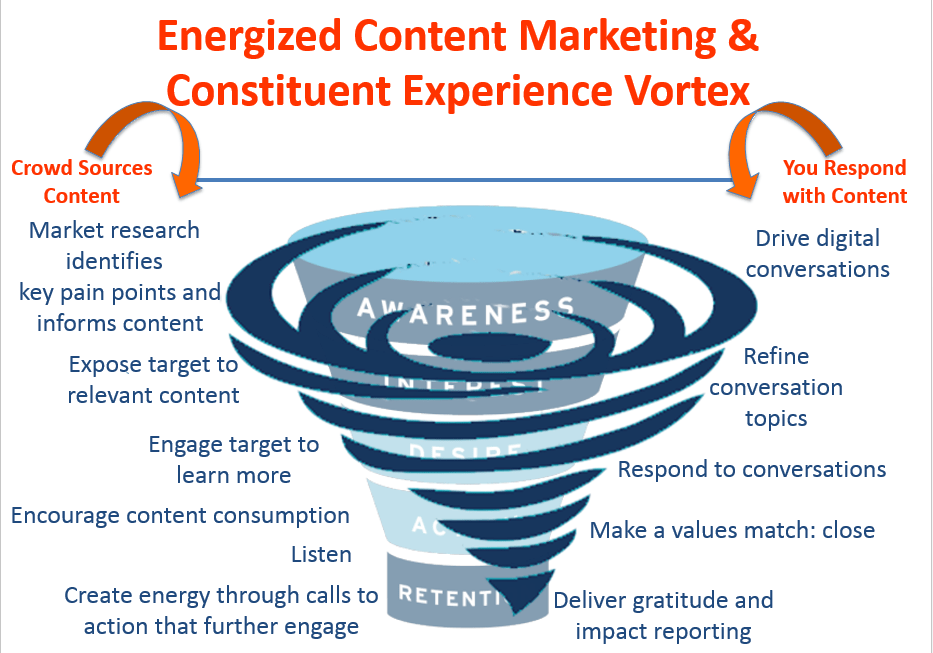
Your biggest return on engagement today will come from meeting folks where they are.
Don’t categorize donors solely by their money. They’re people, first and foremost. Sometimes, when things are going well for them, they become donor-investors helping other people. Sometimes, when other things in life take precedence, they may become recipients of philanthropy. Think of it as a continuous, virtuous circle.
6. Changes to do with new research, data and technology should inform your strategies.
You no longer need to guess about a lot of things.
You can assess where folks come from, what floats their boats, and even what their values are because you can track this information using a number of analytical tools to leverage your data. Even before the advent of AI there were user-friendly tools to track donor retention, downgrades, upgrades, opens, clicks, shares and the like. Some of these come embedded with CRM reports and database dashboards you purchase. And there are also free tools like Google Analytics and The Fundraising Report Card.
Plus, today AI tools help make your data much more actionable.
The more you know about what works/doesn’t work, the more strategic you can be setting goals, objectives and tactics.
7. Changes to do with changing priorities.
If there was ever a constant in the world, it’s change.
Whether you want it to happen or not, it happens. And that means the way you’ve done things in the past won’t always work as well today. Let alone tomorrow. To keep pace you must adapt.
To adapt, you must take stock.
- What are your key objectives this year?
- What are your key challenges?
- What marketing challenges must be addressed to reach your objectives in the current digitally-revolutionized and highly networked world?
Once you have a clear handle around your challenges, then — and only then — can you begin to iterate solutions.


